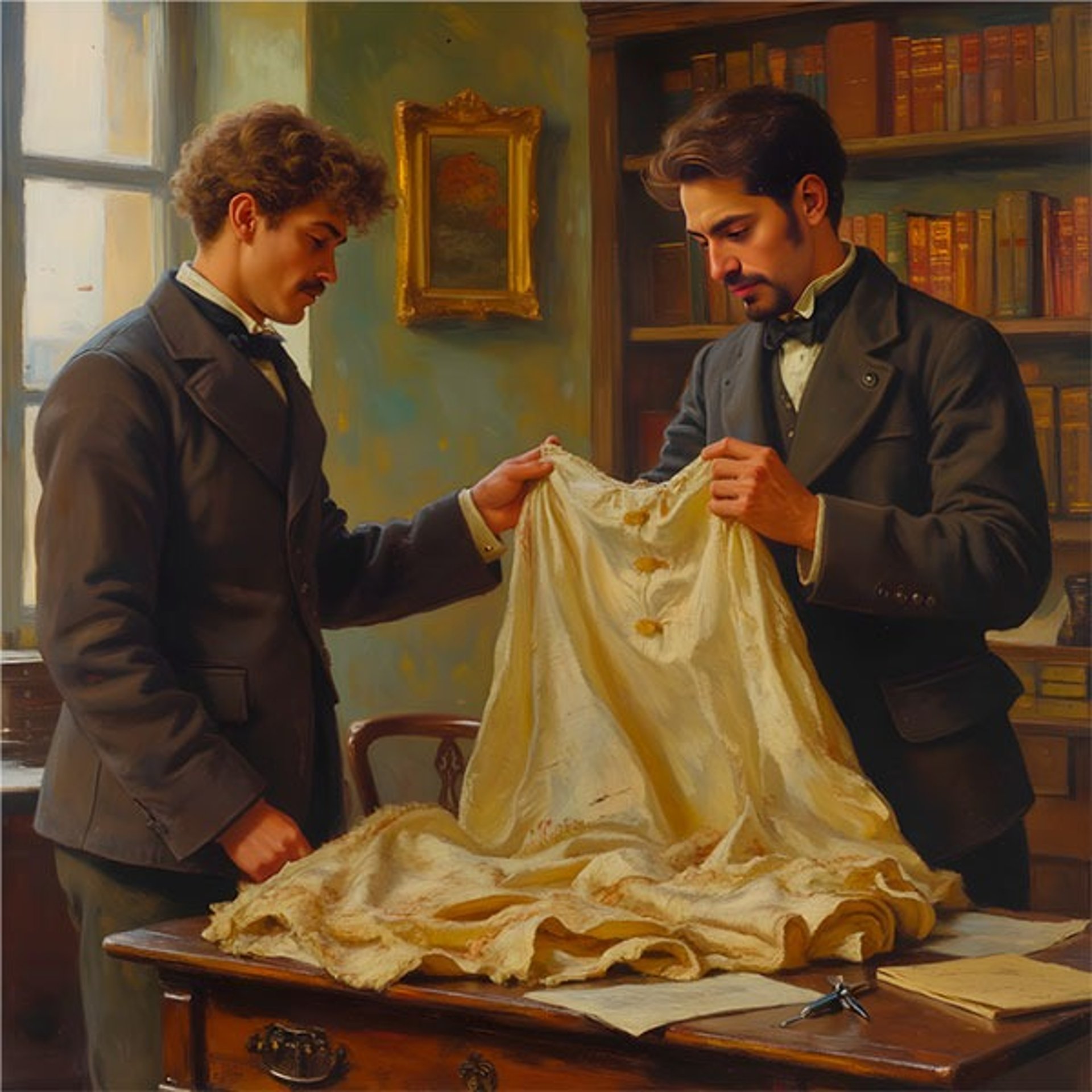
Sample read - Miss Penny's Wedding Dress
My name is Jonathan Wells. I was of age, two and twenty years at the time the events in this story began. My occupation in the beginning of the story was with the Post Office.
Some years have passed since the events described in the story occurred. After years of living in fear of the consequences of telling the story, I am satisfied that the telling of it now will neither open old wounds, nor cause harm to my character and reputation.
The events occurred just as my story tells of them. Now, should any others besides myself who read the account remember, they too will have no cause to doubt my present soundness of mind. Nor should they doubt that the events actually occurred.
Surely, with the years having now passed, my reputation, and even my conduct within society should be proof enough to any doubters, that any indictment regarding my mental state at the time was unjustified. The wrong was against me, but time has been my vindication. My conscious is clear in all accounts before God and man.
But I will not tell the story myself. I have left that task to a trusted friend and confidant who knows more than anyone else, besides myself, the depth and the details of the story.
Through investigations, interviews, and my own accounting to him, he knows the details of the story in the greatest of detail. But the teller’s identity will remain my secret. The story is told in his own words.
***
It was in the cold of the year. Late November. That year it looked like winter would come early. And it would treat the citizens of Miltonburg, and truly, the entire region harshly.
Even with the early arrival of the cold of winter, snow was late in coming. It seemed to many of the residents of the city that it was indeed too cold to snow. Whether that was a blessing or not, depended on who one asked.
Inside, and out of the cold, in a small room on the second floor of the Post Office building located near the centre of the city, Jonathan Wells was at his desk. Across from his desk, but facing his, sat the desk of his co-worker Robert Hamberly. The two men were the sole employees within the room.
Owing to the nature of their work within this room, both men had agreed that the room should be called the autopsy room. To them alone, the room knew no other name, official or otherwise.
It was a drab and dreary room. Both men would readily attest to that claim. Grey walls deserving, but not receiving a fresh coat of paint, met a floor covered with worn, linoleum. The ceiling above, which was once white, was now dull, and could hardly be called white.
A long, ragged crack ran from one corner toward the centre of the ceiling, where it made a sharp turn to the left, and ended where the ceiling touched the wall. That crack gave the room the anticipation of an entire quarter of the ceiling, one day falling. But the crack had been there the entire time of Jonathan’s employment. He knew the ceiling was not ready to fall. At least not yet.
But the room was pleasant in its warmness, and it was easy to forget that outside the building, there was no warmth. At this time of the year, at least.
The room was furnished with, besides a coal burning stove, which accounted for the warmth, two ancient desks of wood, and two steel cabinets purposed for filing records of the work accomplished within the room. The desks were of well scored wood, for it was never, by the ones who decide on such things, deemed necessary to refinish the surfaces.
Individual oil lamps sat on each desk. From the ceiling, in the centre, hung a gas light fixture serving to complete the light within the room. But that fixture gave off a certain odor which a newcomer to the room would notice. But both of the regular occupants of the room had long grown accustomed to, and no longer took note of the smell.
Electric lights would have been welcome improvements to the room. Both men who worked there would have preferred such an improvement, but those who made decisions for improvements, or against improvements, thought it not necessary to upgrade the lighting in this room.
This was an office of the government. And the government makes choices rarely considering the needs of those the choices will affect. Either for the good or for the bad.
For their occupation, the room sufficed, and neither Jonathan nor Robert made it a point of complaint. After all, each man held his own ambition, and making a long-term career in the dead letter department was in neither man’s plans. Certainly not in the autopsy room. Their time would come, and better employment would see them in better circumstances.
***
Now the clock on the wall reminded them that the work day was nearing its end. Then they would both venture out into the cold. Each making his way to that place which made up his private world. And the private worlds of the two men were remarkably different.
But not yet, for another two work hours remained, and the fire in the stove was dying, and a chill began to creep into the room. Robert stood from his desk, and seeing that the coal bucket was empty, taking it, he went to descend to that part of the building where the coal bin was.
He soon returned with the bucket heavy, huffing from the exertion. “Your turn next time,” he remarked upon shutting the door on the front of the stove, as the newly fed fire roared inside.
“Of course, of course,” Jonathan replied, absentmindedly.
“I’ll remind you,” his friend said.
Jonathan, glancing to the clock, said, “don’t build it too hot. We’ve less than two hours to quitting time.”
The other nodded in agreement. He had added three nuggets of coal to the embers still glowing red within the stove. “That’ll do for now,” he said. Soon the warmth returned to the room.
On each man’s desk, a wire framed basket with a white course poplin liner, was placed at the beginning of the day. Within those baskets were envelopes and packages which required their best efforts to decipher the ill written names and destination addresses.
Both of them were good at their deciphering. And they were reasonably successful at solving the addressing mysteries. And once solved, they forwarded the letters and packages on to the rightful recipients.
A third basket sat on the floor between the two desks. There, hopeless letters and packages were tossed, sans ceremony. But an unspoken competition occurred between Jonathan and Robert, as they counted the number of tossed items which actually entered the basket, rather than the misses lying on the floor.
***
The work day was now ended. Jonathan closed the leather-bound book which lay on the desk before him. The bottle of ink was capped, and the pen laid in the drawer. Then with a sigh, he rubbed both eyes firmly with the heel of his hands.
His back ached from bending over in that constant sitting position. One would suppose five years of doing this should have strengthened his back muscles enough to... That he reminded himself of. No. It still ached the same at the end of each day.
Only by the time he arrived at his own flat would the aching be eased. Walking did that. And his young body mended itself quickly. But Jonathan often wondered if the aching position would become an all the time thing in the coming years.
His eyes burned from the strain of the long day spent recording entries into the book. And from examining packages and letters, searching for clues as to the identity of the recipient, or often, the sender.
Like the worry over his back, he wondered if his eyes would in time give way to the constant strain. But for now, he was young, and the young do not dwell lone on the ills and afflictions to come tomorrow. The present is far easier to know and to see. And to Jonathan, the present was the most visible thing to see.
The disappointment which was always the result of unfruitful searches did not ease the strain. For as successful as they were, times of failure were all too frequent. Some letters simply refused to yield up clues to their intended recipients. Some days ended with the pile of unidentified items great within the basket on the floor.
Jonathan hated the repetitive nature of his job. It was the same every day. Each morning letters and packages would fill the baskets on their desks. Even when the two men were fortunate enough to empty the baskets, the next day would be the same.
He had done this for five years. Should he remain in this employment, would he be facing the same filled basket every morning until the day of his retirement? Or perhaps his death. The question left an uncomfortable feeling deep inside him, for looking ahead, he could see no change in his position.
But now it was time to cease their labours, for the end of the work day was at hand. And this day ended with but one item in the basket. An irregular shaped bundle was the sole object within the basket on Robert’s desk. It would wait until the morrow.
Jonathan extinguished the lamp standing on the right-hand corner of his desk. It was now twenty past six o’clock. Exactly twelve hours and twenty minutes since he lit the lamp and began his day this morning.
“Fancy a drink before going home?” The question came from Robert.
“I think that would suit me,” Jonathan answered, while standing and donning his outer coat, and wrapping the wool scarf about his neck, tucking the ends down inside the collar of the coat.
Sally’s scarf. She had knitted it for him, insisting that it was for his health, and that he must wear it in any inclement weather. And that matched the day’s weather.
He loved that she thought so highly of him. Highly enough to worry about his health. That thought brought a smile, which showed itself just enough in the upturned ends of his lips. A warm feeling welled up deep inside him. That too added to the reason for the smile.
Passing through the front door of the Post Office building, giving a passing nod to the evening watchman, and receiving a wave in return, they were now on the street.
“Just time for one, mind you,” Jonathan said. He did not wish to tarry long, as he was expected for supper at Sally’s house that evening. And far be it for him to be late to her house.
The darkness of winter had settled on the world outside, and the wind on the street was bitter. Through the air, from the grey cloud layer above, tiny flakes of snow swirled about. Perhaps this would be the first snow of the winter.
But nothing landed, thus the ground and the pavement they walked on remained dry and free of any of the white precipitation. Holding onto their hats by the brims against the brisk wind, they walked with heads down.
“Are you seeing Sally this evening?” Robert asked, as they approached the pub both of them knew from frequent visits at the end of their work days.
“Aye. At her folk’s house,” he answered. “Supper as usual. ‘Tis Tuesday, you know. They expect me every Tuesday.”
“Every Tuesday. So you’ve said before,” Robert replied, for he already knew the answer to his own question.
“Every Tuesday. When I marry her, I know my life’ll be ruled by the calendar.”
“Even more so, the pendulum of the clock,” Robert returned.
“Truly. You’re right,” Jonathan admitted.
“How are the two of you getting along?” Robert asked.
“Better than before,” Jonathan answered. “That was a nasty affair. She’s the jealous kind, you know. But it was all a mistake. What she thought, that is.”
“You did give her cause for her jealousy,” Robert replied. A hint of accusation was in his voice. “She was right to be jealous.”
“I did indeed. Just a moment’s fancy, it was. Wrong of me, of course. But I learned my lesson. I was not the cause of the thing. But it did catch me, and briefly made me question my commitment to Sally. Temptation was there.
“Only for a moment, though,” he added. “I realized that it’s Sally for me. Now we’re on the up and up with each other. Things are better between us.”
“Good to hear,” Robert replied. “She’s a good lass. She’d be good for you. As a wife, that is.”
“I know. I hope so too. But before I can propose marriage, I must assure her father that I can support her. The way he believes I should. I’m not a man of means, you know.”
“Oh, as our salary makes us men of means?” Robert answered with a laugh. “Tell him you have great prospects.”
“Prospects. That’s what I don’t have,” the other one retorted.
“What of you?” Jonathan asked. “When are you going to quit bachelorhood?”
Jonathan was embarrassingly aware of Robert’s good looks. More so than his own, he thought. With that awareness came a degree of envy. And no little insecurity within himself. Robert was older, by two years. Taller, and with the kind of looks, he knew ladies preferred.
Certainly, when he looked into his own looking glass, he saw nothing to draw the approval of any lady of superior looks. Or even means. And he lacked means. What was there to attract any lady, for that matter? That was a frequent question he asked himself.
But Sally approved of him. She must approve of what she saw when she looked at him. But an uncertainty remained, and it taunted him. She had shown her jealously. But above all, she did, and frequently, proclaim her love for him. That should assure him, he told himself. But still…
Robert was answering his question. “In time, old chap. In time, I’ll settle on one. I’m still looking for that one special lady.”
“Will you ever find one worthy of you?” Jonathan asked. The answer, and the question were made in jest. Partly, at least, for in Jonathan’s estimation, his friend held himself, and his good looks in very high esteem.
Robert laughed in return. “In time. For now, I enjoy the bachelor life. I know I’ll tire of it, and that time may come soon. I don’t know when. But I will know. Providence may see me finding her even before I think I am ready. In the meantime, I don’t lack for the attention of the fairer sex.” Jonathan did not doubt that claim.
“Oh say. That reminds me,” Robert began as he opened the door of the tavern for them to enter. “A curious package came today.”
“Curious? How so? Are you speaking of the one remaining in the basket on your desk?” Jonathan asked,
“That one,” Robert acknowledged. “Just like the others we see day by day. Unreadable addressing. Missing labels entirely. Addresses not real. You know. But this one, is just inscribed ‘Miss Penny.’”
“Nothing more? When did it come?”
“Nothing more. No address of a sender either. Or receiver. I found it just outside the front door when I arrived this morning. I put it in the basket.”
“It was just put by the door and left?”
“Aye,” Robert answered. “No postage stamps on the package.”
“Was it intended to be received by a Miss Penny? Or was it a Miss Penny who sent it?”
“That I don’t know,” Robert replied.
“Why would it be delivered to us with no instructions, no address, and no postage? Who delivered it? I’d like to have a look at it tomorrow,” Jonathan said, his interest piqued.
***
Later that evening, Jonathan sat on one side of the settee in the parlour of the Wrenforth family home. Next to him sat Sally. Her eyes down-turned, she refused to look at him straight on. But her left hand rested in his.
“Do you suppose there’ll ever be a happy normal for us?” she asked.
He thought for a time before answering because he wanted to answer fairly, but also honestly. And to assure her of his heart’s desire for her. “‘Tis my greatest desire, my Love. If I can regain your trust, we’ll know a happy life together.
“I know I made a promise to you,” he continued. “I broke it. It was a moment of weakness, and it was wrong. I knew it then. Of course, I’ll always know it. But you, Sweetheart, are my only love.”
“But you kissed her,” she objected. “How could you? Aren’t my kisses good enough for you? I thought she was my friend.”
He knew no answer to her question. For he had kissed the other girl. The one who had tempted him. She meant no more than to torment the one who did mean the most to him. Before he could prevent it, or even consider the act, she was in his arms. Or more correctly, he was in her arms.
The girl had not done so seeking his affection. Nor had she done so out of affection for him. He had simply been the instrument which Sally’s unscrupulous friend employed to dig afresh an old rivalry.
Sally had thought that all old wounds had healed. By this act, she knew it was not so. But Jonathan had allowed himself to be the instrument by which the hurt was brought new.
Sally had seen it happen. Without thinking, his arms had surrounded the girl. And her arms were around him. And the kiss which he had not expected, happened. It seemed the most natural thing to do at the time. Her face had come close to his, and he knew that she wanted him to kiss her.
And he did. He had not intended it. But he did. And it had thrilled him. As do those things which are forbidden.
He savored the kiss while it remained. Their two sets of lips lingered together. But Sally had seen it. Never mind that he then quickly broke the embrace, and pushed aside the forbidden girl. He came to his senses, but the deed had been done, and it could not be undone.
He did not know her name. She was just an acquaintance of Sally’s. A long-ago school chum who was passing through town and requested to see Sally before moving on to other places. “For old time’s sake,” she said.
But the kiss had enthralled him. Even now, sitting next to Sally, as he thought upon it, the memory of it stirred his imagination. To his own dishonor, and with guilt, frequently in his night dreams, the memory of the kiss was renewed.
Indeed, for a brief time, he had harboured doubt. Had Sally’s kisses thrilled him as the other’s had? The girl was very pretty. Beautiful, even. Sally in her own beautiful way was plain by comparison.
He paused in his thoughts and looked at Sally. Hers was not the common beauty. If she could be called beautiful at all. Olive tone, but pure textured skin, and an oval face tapering to a narrowed jaw and chin. And black hair, pulled tightly into two small buns just below her neck in the back.
Sometimes he wondered about her sense of style. But being a man of some discretion, he was wise enough to never give voice to his opinions on such matters as a woman’s hair style. Her brown eyes were big. Not too big, he told himself. But big in that pretty way. And it pleased him to look at her eyes.
“You know I love no other,” he said. In his hand, the feel of her small hand thrilled him. Small, and vulnerable. Just like her heart, he thought. For that too was small and vulnerable. At the same time, in his conviction, it was a generous heart. And a heart of great size and goodness.
With a sigh, she straightened her back and looked into his eyes. A small smile touched her lips. “We’re going to be okay,” she said, to his great relief.
A curl from the front of her hair fell across her forehead. With his free hand, he brushed it back to the side. She was indeed beautiful. And he did love her. And he desired her. For even now, that heated yearning burned inside him. But he would do nothing to compromise her virtue.
Soon, he knew they would talk of their marriage. He would seek the consent of her father. Then upon the assurance of her father’s favor and blessing, on bended knee he would present his request to her.
Then with both hands, he caressed her face. Drawing her to him, he kissed her with the kiss of one who loves sincerely. He would in time, he knew, forget the taste of that other kiss. He willed himself to that forgetting.
Releasing her, he spoke again. This time apart from the subject of them. Why the thought to speak on other matters came to him, he did not know. But suddenly the package now laying in the basket on the floor in his office captured his imagination.
“A curious package came into the autopsy room today,” he announced.
“I thought they were all curious,” she replied, and with the reply a laugh.
“‘Tis true, my Dear. That they are. But Robert told me this one was of a truly mysterious nature. There was neither sender nor recipient addressing anywhere on the wrapping. Only a name.”
“What of the name?” she asked. “I do love a mystery. You know that.” And with laughter, her spirit was lifted. For the time, thoughts of the forbidden kiss were gone.
“Someone known as Miss Penny.”
“Miss Penny? Nothing more?”
“Nothing more. Tomorrow we’ll search over the entire package. Perhaps we’ll discover a faint address, or other helpful information regarding the rightful recipient. Or perhaps the sender.
“But it cannot go further as there is no paid postage. Even if we found a forwarding address, it wouldn’t be sent. Unless it was with the intent of requiring the receiver to pay.”
“And if you find nothing?” she asked.
“Just as with all others like it,” he answered. “Locked away for a time. If no one claims it, then we open it to find out what it contains. Then it’s to public auction. If it’s anything of value, that is.”
“What do you think is in the package?” she asked. A sense of curious excitement in her voice. “Who do you suppose Miss Penny is? Or was?”
Chapter 1
Chapter 2
The package lay on the desk before them. Robert turned it over so that the top – presuming it was the top, for the end of the wrapping lay on the bottom – lay face down.
The package was soft and flexible, and wrapped in simple brown wrapping paper. Twine wrapped around it on the four sides, and the paper was held together by tape.
There was nothing on the back side. Just as nothing had been found on the front side. The only writing anywhere to be found was in pen on the top, near the upper left corner. “Miss Penny.”
“Something fabric inside, I think,” he stated, squeezing it with his fingers.
Jonathan stood. And with the thumb and forefinger of his right hand cradling his chin, as he often did while pondering a curiosity, he nodded in agreement, for it also seemed so to him.
“It’s not officially mail,” Jonathan answered, remembering that Robert had found it on the step before the Post Office door. There were no postage stamps on the package. “It didn’t come by way of the Post. What prevents us from opening it? What rule?”
Robert thought for a moment. “Nothing, I suppose.”
The twine was cut, and the paper unwrapped. What was revealed was a faded white garment. Jonathan unfolded it, and held it up.
“I say, old man. But it looks to be a wedding dress,” he said
“A touch faded,” Robert added. “An old rag. Just put it in the rubbish bin.”
“No. Not yet,” Jonathan replied, for he felt a sudden and unexplained interest in the garment. “Let me take it home with me tonight. I want to show it to Sally. She has an interest in old garments. Besides, we should not discard it too hastily. Perhaps the owner will come calling for it.”
“Perhaps you’re right,” Robert acknowledged.
In his own flat that evening, on a clothes hanger, he hung the wedding dress in his bedchamber wardrobe. Tomorrow evening he would show it to Sally, when he called on her. He sent her a message requesting to see her that next evening. She was free, and upon telling her of it, she was eager to see the dress,
***
Jonathan was a faithful follower of his routine. He had an evening routine. Except for those evenings he spent with Sally, he kept that routine faithfully. This was one of those routine evenings.
Being a bachelor, and having no housekeeper or cook, and not being inclined toward the cooking arts, he took his supper out. Better to eat what was prepared by someone else, was his belief.
Supper with Sally and her family on those days when he was invited, was pleasing to him. And though he never admitted as much to her, or anyone else, it saved him the price of such a meal elsewhere. Not that that reason excelled above his desire to be with her. It did not.
A nearby tavern which served up a handsome breakfast, and at a fair price, satisfied the first meal of his day. A sandwich vendor with a horse drawn wagon which was very much, a kitchen on wheels, made daily stops on the street in front of the Post Office around the mid-day hour.
The sandwiches were tasty, meeting his approval. The same tavern where he took breakfast, provided him with a suitable supper on his way home to his flat at the end of each work day.
His evening routine, once home, commenced with the shedding of the uniform of his occupation. In a house robe and slippers, with a book in one hand, and a glass holding brandy in the other, most evenings he settled comfortably into the high-back wing chair in his bedchamber.
Or the mate of that chair which stood in his parlour, if that suited his mood more closely. There he would read, and reflect, and share in the dreams the words on the pages put into his imagination. Then after a time, sleep tempted him into its clutches. Sometimes near the mid-night hour.
Often his evening reading was hindered by the intrusion of thoughts of the day, and this evening was certainly one so interrupted. Between thoughts of Sally, and the mystery of the dress, he found it hard to give proper attention to the words on the pages of the book.
This evening deciding on the chair in the bedchamber, he sat a lighted oil lamp on the table to the right of his chair. Rather than using the coal stove in the parlour, a small fireplace in the bedchamber burned with a small fire.
That was as he had made it. But it sent forth its small warmth, and that was comfort enough. The steam radiators were silent at the time, but they too added their own warmth to the rooms within the flat.
Now comfortable, putting aside other thoughts not related to the story in the book he held, he commenced reading until unaware, sleep overtook him well before his accustomed bedtime.
***
He found himself startled awake. The book had fallen to the floor, and the glass he had been drinking from, now sat empty on the small table by his side.
Had he heard something to awaken him? Or had something in a dream startled him, awakening him? He did not remember dreaming in that sleep. But neither did he remember falling asleep.
Almost, there was that feeling one gets when another person steps into the room where before, one has been alone. But there was no one there besides himself. The feeling quickly passed, and he dismissed the thought of it. He was alone.
Picking up the book from the floor, he searched for his place within the book, for the paper serving as a bookmark had fallen out, and the book had landed closed. He thumbed through the pages. Presently he found the page where he had last read.
But now his interest in the story passed. And the sleepiness which had prompted the dozing was gone as well. His restlessness prompted him to change his routine for the evening. After all, his solo existence obligated him to no one but himself, and if his mood demanded another doing, he would do what his mood told him to do.
He dressed with enough outer coverings to ward off the outside cold. A heavy great coat over his long-sleeved woolen shirt, and with Sally’s scarf wrapped around his neck. On his head, he donned a billed cap with pull down ear covering flaps. Then he ventured onto the street.
Lacking a thought, and certainly not a destination in mind, he simply began walking. Upon stepping to the sidewalk in front of his building, he turned and walked left. He would just walk, even if to no place in mind. Then upon tiring of the walk, he would return, and perhaps then sleep would be more agreeable.
The light from the gas street lamp he passed just before his building, cast a pale amber covering to the brick pavement of the street, as well as the sidewalk in front of the building. Walking ahead, his shadow ran before him, and lengthened as the street lamp fell behind him.
But then another shadow appeared. Shorter in length than his, but in stride with his. It was by his left side, but beginning somewhat behind him. His heart skipped a beat for he knew himself to be alone on the street.
Turning about, he saw that he was alone. Now there was but one shadow. His own. Never mind. It was only his imagination. Or a trick of light.
For the next half hour, he sat on a stool before the bar in a small and quiet pub a few blocks from his building. No reason had been made to select that particular pub. But it was on his path, and the light from inside invited him to stop here. The atmosphere inside was warm.
Taking a seat on a stool at the bar, he waited for the tender of the bar, who was just now ringing the tab for a customer who was finishing the last of his drink, and donning his coat. Shortly, a mug of beer was brought to him following his request.
“A cold night t’ be out, would you say?” The inquiry came from a nearby table. The statement seemed to be aimed at him.
Turning, he saw the speaker, sitting alone at a table for four, mere feet from his own stool. A man who looked to be of advanced age sat looking at him. Grey of hair. Grey of complexion. And if voices had colour, his would have been the colour of grey. Likewise, his raiment was mainly of grey.
“Aye. ‘Tis that indeed,” Jonathan replied, desiring to be courteous, he turned on his stool to face the older man. The old man nodded in reply, and lifted his own glass toward him. He lifted his own in return.
“You don’t look like th’ usual t’ be here this time o’ night.” The man was intent on conversation, and Jonathan, lacking other amusement, obliged.
“Ah, but here I am, Sir,” he replied. “Just as you are out on this cold night. It’s not that late an hour, you know.”
“Indeed. Indeed,” the grey man answered, nodding in agreement. “Say, is there no one at home t’ keep you company? I’ve no one, myself. You’re not married, are you?”
“That I am not Sir. Not yet, at least.”
“Ah, you’re lookin’ to be married, are you?” the grey man asked.
“I have a prospect for marriage,” he answered, thinking of Sally, and wondering at the man’s curious line of questioning.
“A fiancée, really? Was she th’ one followed you t’ the door just now? She didn’t come in though. I wondered ‘bout that. Thought she was with you. Then I didn’t see her no more.” The man’s words drifted on as though rambling to himself.
“What woman?” Jonathan asked, now startled, but also curious. “There was no one with me. I came here alone.”
“Oh I suppose it’s a never mind,” the old one answered. “Just thought I saw. That’s all. My old mind playin’ tricks, I’ll wager.” He ended that with a hearty laugh as though he enjoyed making jests at his own lacking.
Then he continued. “By th’ light of th’ lamps out front, you know. I thought I saw her clearly. Through that window yon.”
He gestured with his left hand toward the front of the pub where the very large window opened the view to the street outside. The light from the lamp pole was sufficient to see those who passed to and fro along the sidewalk. But now there was no one to be seen.
Jonathan’s curiosity was aroused by now. “What did you see, Sir? Or think you saw?”
“Nothing, my man. Nothing at all. Just my imagination, methinks. But…”
“But what, Sir?”
“Just ‘fore th’ door. Just there.” He pointed to the front of the building, where the front door with its large glass window allowed a good view of anyone who would approach the door to enter. “She was right aside you. Then you came in. Alone.”
A chill touched him somewhere inside. Why, he knew no cause, but nevertheless it was a new coldness inside, and it disturbed his comfort. “What did she look like? If you remember, that is.”
“‘Twas th’ strangest thing. Truly. Didn’t get much of a look at her face. Now I don’t rightly remember th’ colour of her hair. I think it was covered up in something. A covering of some kind. I think. ‘Twas only th’ most briefest of glances, you know.
“But she was dressed in… No, that could not be. But it looked to be. Aye. Something like a bride wears. You know that kind of dress they marry in.”
“Are you sure, Sir?” Jonathan asked. Now the chill grew inside his frame. But surely it was simply the old man’s imagination. Perhaps the old man was mad after all.
“I’ll assure you, Sir. There was no one with me. I walked here alone.”
“As you did, young man. Surely as you did.” The grey man spoke no more to him, but returned to his own drink, and his own supper which had just now been brought to him.
One more mug was ordered, and brought his way. He finished half of it. Then paying the invoice, he donned his coat, and with hat in hand, and waving a farewell to the old man, he passed through the front door of the pub, and onto the sidewalk outside.
The snow had increased during his time inside the pub. Now a thin layer of white lay on the sidewalk. No one else was in sight, and the fresh snow on the ground was free of footprints. For now, his would be the only ones. The quietness which a fresh snow brings mesmerized him again, just as he remembered it doing so from early childhood on.
Sleepiness crept upon him as he stepped into his flat, and noting that his pocket watch agreed with the clock on the parlour wall, that the hour was late, he entered the bedchamber and began to undress and prepare for bed.
Sleep quickly overcame him. He dreamed, for now he found himself in a church. And the church was adorned for a wedding. Not his wedding. He knew that, for his place was among the guests. But neither did he know who was about to be wed.
A man and a woman stood before the clergyman. She was dressed in white. And he wore formal black. They were strangers to him, for he knew not their names, nor their faces.
Nor did he know why he was present. Surely in response to an invitation. Or he supposed so, at least. But such are the unanswered questions within dreams.
He awoke with a start. He remembered the dream being broken, and suddenly he was awake. Somewhere within the flat, he heard a sound. The sound was faint. He listened.
Then fully awake, he heard it again. It was not from within the dream, as is often the case when dreams seem to blend with waking memories.
Faint, but there it was again. It came as the sound of weeping. It was the sound of a woman weeping. Somewhere, within his flat, a woman was weeping.
But he was alone in the flat. Thus the sound could not be real. Then it ceased. There was no further sound. Only the sound of the ticking of the clock on the wall of the parlour.
He lay awake, listening. The desire for sleep now lay behind him, yet the morning was hours away.
Perhaps he had imagined that he heard it. Or could it have come through the wall from the flat next door? An elderly widower lived in the flat next door. But he was a quiet neighbor. And never before had he heard sounds coming through the wall.
Perhaps the sound had come from the flat below. By way of the steam pipes, for the openings between the floors around the pipes often did allow sounds to pass through. After all, sometimes the path of the pipes through the floors to the steam radiators allowed sounds to pass between the flats. Surely that was it, since it offered the most likely of explanations.
The clock in the parlour chimed two o’clock. He lay awake.
The clock chimed three o’clock. Still, he lay awake.
So it continued for the remainder of the night. The sound of weeping did not reoccur, but he remained awake and wondering.